Portuguese, Japanese and Persian Streets in One Bend of the River
At its height, Ayutthaya was one of the largest cities in Asia, and it built that size partly on foreign trade. The merchants, diplomats and adventurers who arrived from the sixteenth century onward did not scatter through the city — they settled in designated quarters along the river's edge, each community granted land, a degree of self-governance, and the right to maintain its own religious buildings.
The logic of the foreign quarters
The Chao Phraya bends sharply as it passes Ayutthaya, and the city was built on the island that the river and two smaller channels enclosed. Foreign merchants were settled deliberately outside that island, in communities strung along the banks downstream — close enough to the palace for diplomacy, close enough to the warehouses for trade, and separated from the Siamese core of the city by water. The arrangement suited both sides. The court wanted revenue from foreign commerce and the intelligence that came with it. The merchants wanted security, legal recognition, and somewhere to build a church or a mosque without negotiation each time.
The word most often used for these settlements is ban, meaning village or community — Ban Yipun for the Japanese quarter, Ban Moor for the Persian-Moorish one. The term signals something more than a neighbourhood: each ban functioned as a semi-autonomous unit with its own headman, its own jurisdiction over internal disputes, and, in most cases, its own house of worship. Ayutthaya's foreign policy was expressed partly in how generously it drew these boundaries.
Portuguese, Japanese, Persian: three communities and their traces
The Portuguese arrived first. A treaty was signed in 1516 between Ayutthaya and the Estado da India — Portugal's Indian Ocean empire — and the Portuguese community that followed was the first European settlement in Southeast Asia to receive formal land grants from a Southeast Asian court. The site lay on the south bank of the river, downstream from the island. A Catholic church was built there, dedicated initially to Saint Dominic, and the Portuguese community maintained a presence in the city for over a century. What survives at the site today is the archaeological ground plan of the church and a scattering of fragments — Portuguese glazed ceramic tiles, foundations, the outline of an apse. The settlement became known to later scholars as San Pedro, after a subsequent dedication, and excavations of the Portuguese quarter at Ayutthaya have confirmed its extent and its material culture in detail.
The Japanese quarter, Ban Yipun, occupied land on the same south bank, slightly upriver from the Portuguese settlement. Japanese traders had been moving through Southeast Asia since at least the fifteenth century, and by the early seventeenth century Ayutthaya's Japanese community was substantial — estimates place it at a thousand or more residents at its height. Many were Catholic converts fleeing the persecution that followed the closure of Japan under the Tokugawa shogunate, which began tightening from the 1610s onward. This gave the Japanese quarter an unexpected complexity: it was at once a trading post and, for some of its residents, a refuge. The most documented figure to emerge from it was Yamada Nagamasa, a merchant-adventurer who rose to command the Siamese king's Japanese guards and was eventually appointed governor of Nakhon Si Thammarat in the south. His career illustrates how porous the line between foreign resident and Siamese official could be. The quarter declined sharply after 1632, following political violence connected to a succession dispute, and the Tokugawa restrictions on Japanese overseas travel meant it was never rebuilt. The site of Ban Yipun is marked today; a small Japanese memorial shrine was established there in the twentieth century.
The Persian and Moorish quarter — Ban Moor — sat on the opposite bank, to the east of the island. Persian and Indian Muslim traders had been significant in Ayutthaya's commerce since the fifteenth century, and the court employed Persian officials in senior roles through much of the seventeenth century. The most striking instance is the Bunnag family, whose Persian ancestor Sheikh Ahmad arrived in Ayutthaya in the early seventeenth century and whose descendants became one of the most powerful noble lineages in Siamese history, holding the office of Samuha Nayok — prime minister, effectively — well into the Bangkok period. The mosque associated with the quarter, Masjid Khu Tha, is sometimes cited as the oldest mosque in Thailand, though the current structure is a much later rebuild. What survives more completely is the cemetery, where headstones with Persian inscriptions remain legible, and the layout of the quarter itself, which French maps drawn in the late seventeenth century recorded in some detail.
The French and Dutch, and what the maps show
If the Portuguese, Japanese and Persian quarters represent the earlier waves of settlement, the French and Dutch arrivals belong to the later seventeenth century, when Ayutthaya's international entanglements grew more complicated. The Dutch East India Company — the VOC — established a trading post in Ayutthaya in 1608 and maintained it for much of the century, their warehouse and residence occupying a site on the river that Dutch records described carefully. French involvement peaked in the 1680s under the reign of King Narai, when the court of Louis XIV exchanged embassies with Ayutthaya in one of the more improbable diplomatic episodes of the era. The Greek adventurer Constantine Phaulkon rose from East India Company seaman and interpreter to Narai's principal foreign minister during this period, facilitating the French relationship until Narai's death in 1688 triggered a reaction that expelled the French and ended Phaulkon's life.
French maps and accounts from the 1680s, particularly those associated with the embassy of the Chevalier de Chaumont and the subsequent mission under La Loubère, are among the most detailed primary sources for the city's layout. They show the foreign quarters clearly, positioned along the river's south and east banks, and give the city's population as somewhere in the range of several hundred thousand — a figure that made Ayutthaya comparable in scale to contemporary London or Paris.
What burning left behind
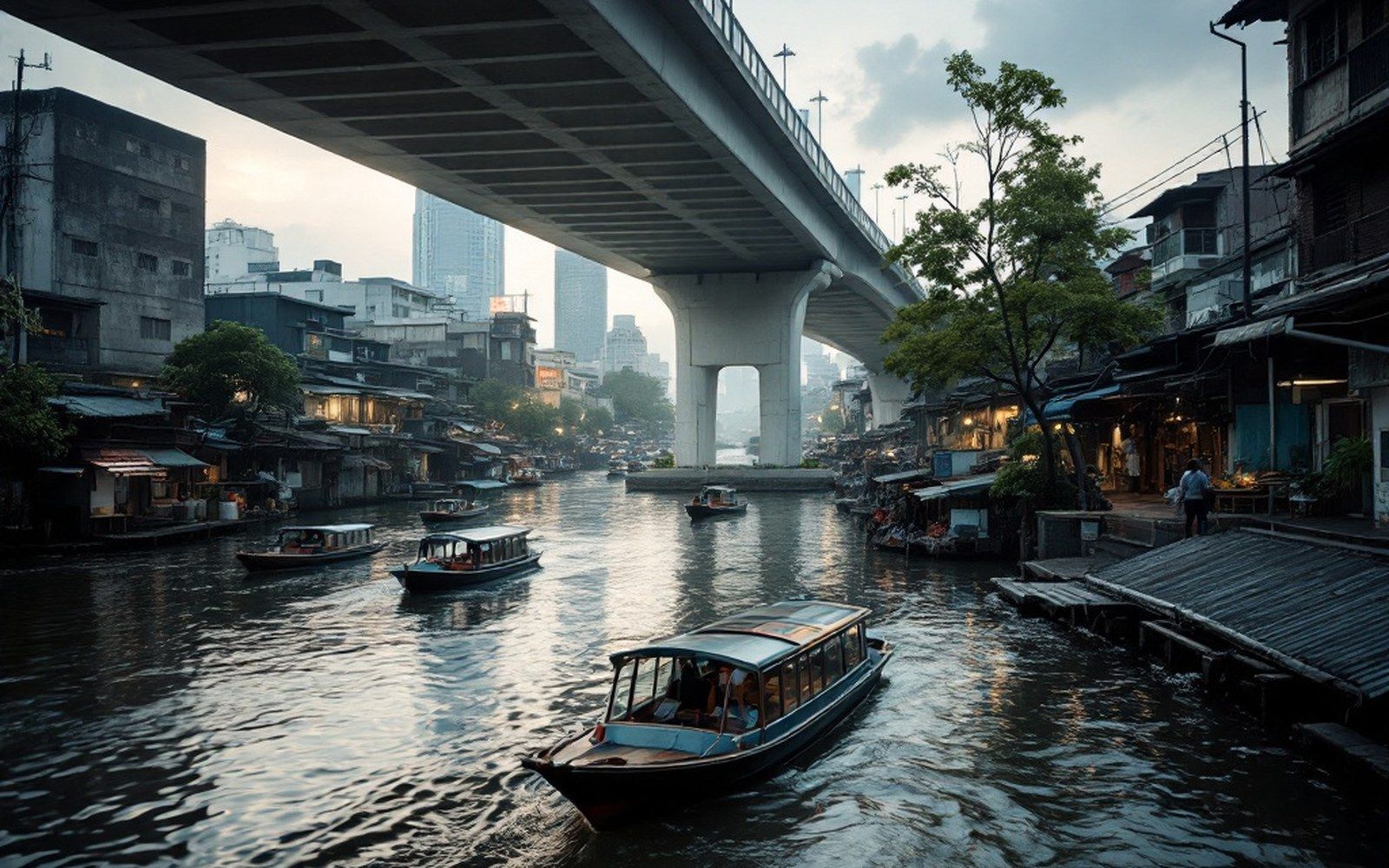
The Burmese siege and destruction of Ayutthaya in 1767 ended the city as a functioning capital. The foreign quarters, already reduced by that point — the Japanese quarter had been effectively empty for over a century — were consumed in the same catastrophe as the temples and the palace. What archaeology has recovered since, particularly from the Portuguese quarter, suggests that material culture survived in the ground long after the buildings above it were gone: ceramics, coins, religious objects. The Foreign Quarters Archaeological Site is now part of the broader Ayutthaya Historical Park, a UNESCO World Heritage Site since 1991, and the Portuguese settlement in particular has been the focus of sustained excavation.
The river bend where all of this happened is still there, the Chao Phraya still running past the same curve of bank. The warehouses and churches and mosques are gone or rebuilt or reduced to foundation lines. But the underlying fact — that a premodern Siamese city chose to house Europeans, Japanese, Persians and Malays in designated riverside settlements, and managed that plurality for roughly two and a half centuries — is not a minor footnote. It shaped the city's economy, its court politics and, through families like the Bunnags, the institutions of the Bangkok period that followed.