Every building has a smaller building beside it
A san phra phum stands at the edge of almost every plot in Thailand — not decoration, not folklore, but an active obligation maintained every day.
What it is and where it stands
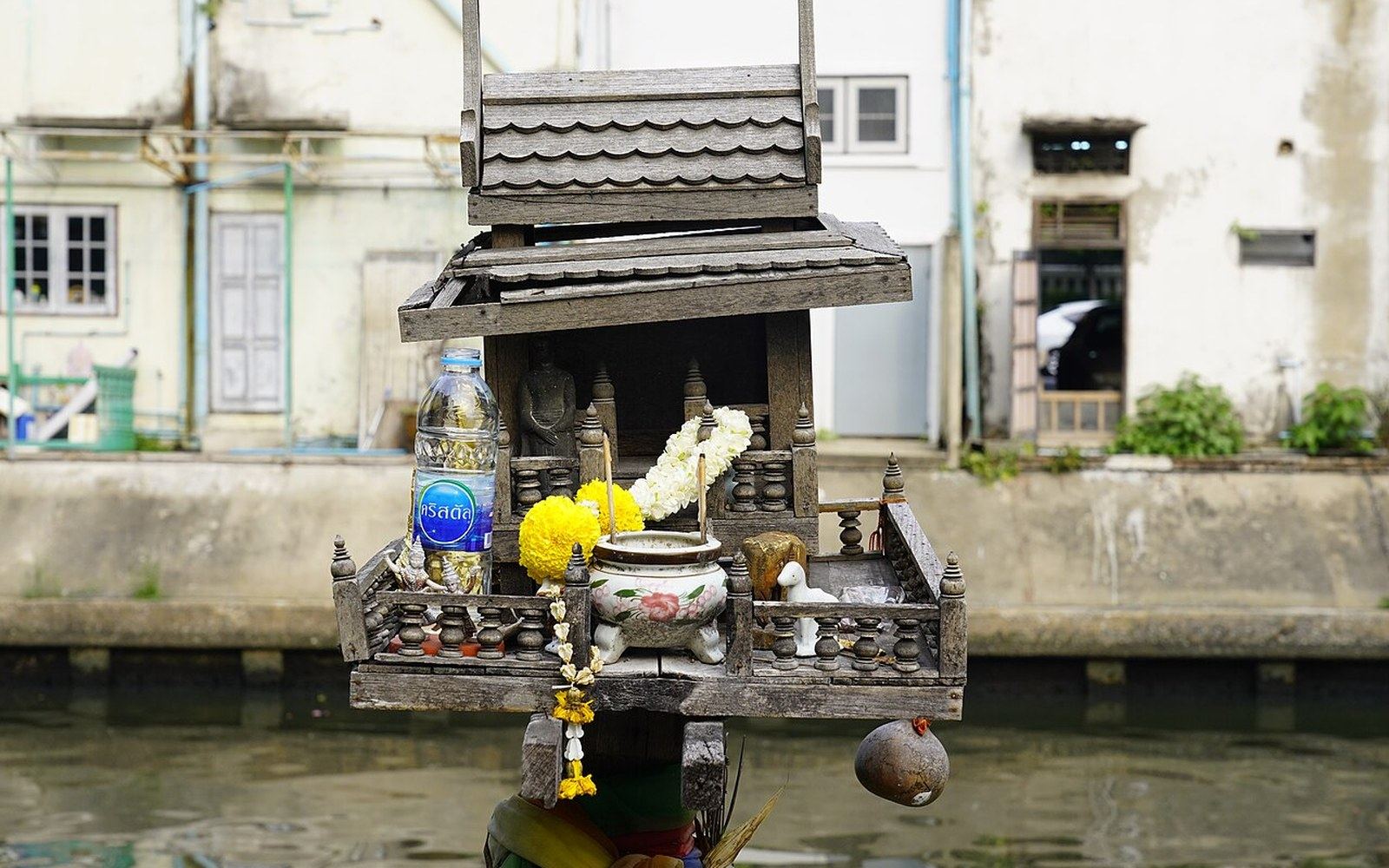
The san phra phum — spirit house — is a miniature pavilion placed on a pedestal at the boundary of a site to accommodate the spirit displaced when a building goes up. The principle is one of compensation: construction disturbs the ground, and the displaced spirit is given a residence of its own as settlement. Every category of building generates this obligation. Shophouses in Yaowarat carry one on the pavement beside the entrance. Office towers on Silom have them at the edge of the forecourt, sometimes scaled to match the ambition of the building itself. Petrol stations, hospitals, government offices, rural homes: the san phra phum appears without variation because the rule does not distinguish by prestige or function.
Placement is not a matter of taste. A spirit house must not sit in the shadow of the main building — the shadow of a structure is considered inauspicious to cast over the residence of the spirit — so the pedestal is positioned to keep the sun falling on the pavilion across the full arc of the day. A qualified person, often a Brahmin priest or a respected elder with knowledge of the relevant texts, determines the correct position, typically to the northeast of the main structure, though site geometry adjusts this. The calculation is geometric rather than intuitive, and getting it wrong requires a new ceremony to correct it.
What goes inside and what happens each morning
The pavilion itself follows an established form: a single-spired roof in the style of a Thai temple building, elevated on a column of one to several feet, with a small interior ledge that serves as a shelf. Inside, figures are placed — a small male deity representing the presiding spirit, often accompanied by attendants, horses, elephants, and servants rendered in ceramic or resin — making up a miniature household. These figures are not decorative choices but a standard set fulfilling an expected role; their presence constitutes a proper arrangement rather than a personal one.
Maintenance is daily. Fresh garlands of jasmine and marigold are replaced each morning, the jasmine being particularly associated with reverence across Thai ritual practice. Incense is lit, usually in a count of three or multiples of three. Small offerings — rice, water, fruit, occasionally red soda in recognisable glass bottles, a preference whose origins are attributed to a wish once granted — are set on the shelf. The offerings are not left to accumulate indefinitely; they are cleared and replaced, so the spirit house on an occupied site is always fresh. A neglected san phra phum, its garlands dried and its incense holders empty, reads as a sign of an unoccupied or troubled site.
The wai — the pressed-palms greeting that signals respect in Thai social life — is given to the san phra phum as part of the daily maintenance, and by passersby who maintain a relationship with the spirit of a particular site. Workers at a construction site may wai the temporary spirit house erected at the start of the project before the permanent one is installed; this temporary structure is understood to hold the spirit during construction rather than leaving it without a home.
When a building changes
If the main building is demolished or significantly altered, the spirit house requires attention. Moving a san phra phum without ceremony is considered as disruptive as its original displacement, and a formal ritual — merit-making, offerings, and an invitation to the spirit to relocate — accompanies any repositioning. Old spirit houses that have been retired from active use are not thrown away; they accumulate at designated sites near temples, where thousands of spirit houses stand in rows, the small populations of demolished buildings, relocated businesses, and rebuilt homes all gathered together in an arrangement that amounts to a record of the city's construction history.
Related
The things a visitor notices before anyone explains them